

There is a man on the internet who claims his AI agent made £200,000 while he slept. What he doesn’t mention is that he started with £300,000.
He is not the only one. Every day someone new is selling you the same story. Their agent closes deals. Their agent finds keywords then writes their content. Their agent runs their funnels while they’re at the gym, on holiday, spending time with their family, or baking sourdough bread. You, meanwhile, are still writing your own posts with Claude as your assistant. Still planning your own content with Perplexity. Still spending your time crafting and honing beautiful marketing strategies to reach your perfect customer.
And the implication is always the same. You are behind. They are ahead. The gap is widening.
If you can feel the FOMO creeping in, that’s exactly what’s meant to happen. You’re supposed to watch everyone else building agents, panic, and jump in yourself.
But I have spent a lot of time on AI agents in the last two months and I can tell you with some confidence that the hype about AI agents is mainly hype.
I have read the reports. I have reviewed the stats. I have watched the videos. I have tried the tools. And three things have become very clear to me:
Many of the people claiming to be using agents have a very loose definition of an agent. They are using ChatGPT or Claude to help them write content. They might have a sophisticated prompting system, and they might be saving loads of time while increasing their output. But what they are calling an agent is actually a simple chatbot (see my definition of agents later).
A smaller group that are actually using agents to do their marketing at scale are mostly doing it badly (with a few exceptions where professional developers have been involved at much expense). They have agents that write exactly the kind of content you would expect a chatbot with no human oversight to write. Agents that send templated outreach that infuriates its recipients. Agents that produce the kind of output that makes no one buy. These AI agents for marketing are real. They’re also terrible.
There is another group of people who are using home-made agents to do specific, defined, low-thinking, repetitive tasks (I give some examples later in this piece). They are getting a lot of benefit from their AI agents. They haven’t replaced anyone, but they have improved their workflows and learned a lot about AI in the process. But they operate largely under the radar because this stuff seldom makes for good social media content.

So what exactly is an AI agent?
To understand what an agent is, you need to understand that there are four ways people work with AI right now.
The first is chat. You open ChatGPT or Claude, you ask a question, you get an answer, you take that answer and do something with it. Most people are here.
The second is automation. If something happens, then something else must happen next. You set a scheduled task every morning for ChatGPT to send you a reminder. That’s an automation. No reasoning. No decisions.
The third is an agent. This is where the AI isn’t just answering a question or following a rule. It’s reasoning. It’s got an LLM as its brain, and it is making choices. And then it is taking actions off the back of those choices. It works across multiple tools to get to the goal you have defined. An agent might send an email, having decided on its own to personalise it based on the recipient’s work history. Or it might draft a blog post for you, having first read through your last ten posts and decided on its own which angle to take.
The fourth is a multi-agent system. This is where you have agents managing other agents. One does research and hands off to another that writes content, which hands off to a third that publishes. Each one has a role. Each one has a boundary. (This sounds great, but keep reading to see why this is fraught with issues).
When someone tells you they’ve built an AI agent for marketing, often what they are really talking about is the first or the second one. Sometimes it’s the third. And often, if it is a genuine agent, what it’s doing is very low-stakes - which not a bad thing - it’s where agents really shine.
Bad AI marketing agents are easy to build
Building an agent that writes generic blog posts, sends templated outreach, and publishes mediocre content across five channels is now genuinely easy. The tools are there. The tutorials are everywhere. A motivated person with a couple of hours and a Claude Cowork subscription can get one up and running with little friction.
The limitation is not building the agent. It’s making it useful. Yes, an agent can easily find content on the web and reorganise it for your own blog. It can do that way faster than an average marketing assistant. But no one ever won at marketing by reorganising other people’s content. You’ve just made it cheaper and faster to do something that you shouldn’t be doing anyway.
Good AI marketing agents are harder to build
Not because it’s hard to plug Claude into Zapier into a keyword research tool into a database. That bit is easy. What’s hard is getting the agent to do something worth doing, to a standard worth doing it for.
If you’ve ever interacted with any AI chatbot, and you have standards of any kind, you know this already. The first version of anything it produces is disappointing. Frustrating. A bit off. You rephrase. You push back. You ask it to try again. You give it more context. Ten times. Sometimes a hundred. Until together you create something worth using.
That back and forth is the hard bit. And that’s also the bit an agent has to skip in order to operate at all.
Real marketing agents are good at the unglamorous stuff
There are things in marketing you still have to do that take up time but don’t require much judgement. Reformatting a blog post for LinkedIn. Tagging a CRM. Cleaning up a lead list. Pulling together a week’s worth of competitor research. Summarising an hour-long recording into bullet points.
None of this is marketing strategy. It’s the work around the edges of marketing. The admin. The reformatting. The pulling and sorting. The things you put off because they’re boring, then resent having to do at 11pm on a Sunday.
Hand these things to an agent. It will do them faster than you. It will do them at 2am. It will do them while you are at the gym, on holiday, or baking sourdough bread.
If you’re vibing with this, a quick ❤️ tells me I’m on the right track.
So how do you build an AI agent?
The best place to start is a task you already do regularly. Something small. Something repetitive. Something where the rules are clear and the stakes are low.
It’s relatively easy to build an agent. Ask Claude, ChatGPT, or Perplexity to talk you through the steps.
For me, that task was turning my Substack posts into LinkedIn posts. Every time I publish something on Humans in the Loop, I want five LinkedIn posts promoting it, each from a different angle. I used to write them myself. It took about half an hour. It was boring and not creative - the creative part was writing the post in the first instance.
So I built an agent for it. Actually, I built the same agent twice. Once in Claude Cowork and once in Zapier. The Cowork version scans my published content every day at 9am.
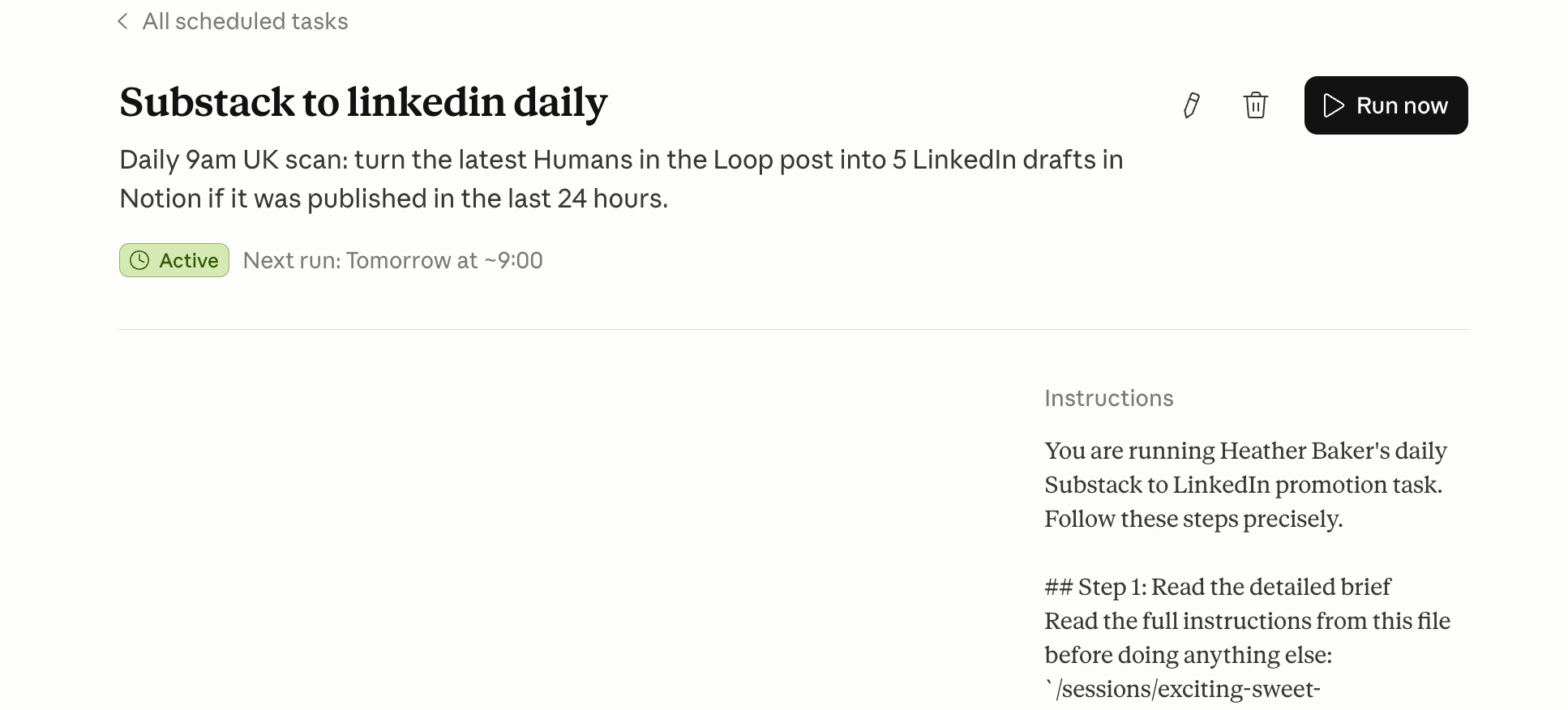
The Zapier version watches an RSS feed and then acts immediately.

Both do the same thing: read a new piece, work out the argument, and draft five LinkedIn posts from different angles. The drafts land in my Notion content calendar, and I review, approve, and schedule them from there.
Five minutes instead of thirty. The agent is saving me the time I used to spend on the bits of marketing that were necessary but time consuming.
Where agents break
Building an agent for the unglamorous stuff is worth doing. But even if your agent is low stakes you do need to understand the risks. Agents break. Here’s how.
Automating the wrong thing. Building an agent to produce generic content, faster, is not marketing. It’s slop at scale.
Hallucination. Agents use LLMs as their brain, which means they will invent a statistic. Misattribute a quote. Publish something factually wrong under your name.
Workflow changes. A tool changes its API. A format shifts. Something you didn’t know was brittle stops working at 2am. Someone has to fix it, and that someone is usually you. Maintaining agents is a substantial job.
Missed nuance. Ever asked an AI to summarise something only to find it’s almost right, the emphasis is wrong? Well, when you hand tasks off to an agent, this happens all the time
Busy work at scale. An agent can simply be a massive waste of time if it is automating something that should never have been done in the first place
If you got caught up in the agent FOMO, you are not alone. It happens. The claims are loud, confident, and relentless. But if you dig deep and know what you are looking for, there is real gold to be found
This happens to a lot of people a lot of the time, but it happens less often to the AI fluent. The more you know about how these tools actually work, the harder it gets for anyone to convince you that their agent is running their marketing function while they bake sourdough and their marketing manager searches for a new job. My AI Fluency for Leaders course is built exactly for that. It’s CPD-certified. 3 hours. Online.
And if you want to find out more, I recently ran a session on AI agents for marketing with Ferdie Bester, founder of NightJarr, who builds agent workflows for real businesses. You can watch the recording here.
This resonates alot! I've been asking within my network for success stories of people implementing agents for themselves, but usually the answers I get are those stuck at level 1 or 2 - it would be great if you have more examples of 3 & 4, especially in the marketing context! Perhaps the next article? :) thanks!
Loved this post, Heather! Especially liked where agents break.