

“Camera-equipped smart glasses are no different from CCTV in the supermarket, the car park or the office lobby, doorbell cameras, dashcams, the cameras on the bus. You have been on camera continuously for twenty years and it hasn’t ruined your life. So why do you care so much about a camera on someone’s face?”
“And what about blind people? These glasses can transform their lives. Are you really going to take that away?”
Those are the rebuttals that arrive within thirty seconds of anyone raising an objection to smart glasses. Let’s clear them out of the way so we can have a grown-up conversation about what’s actually happening.
How CCTV differs from smart glasses
I’ll start with CCTV. CCTV has an owner. A named operator with a lawful basis for recording you. A retention policy. A legal obligation to tell you the cameras are there. And a complaints route that ends at the ICO.
That system is far from perfect. Sainsbury’s ejected the wrong man from its East Dulwich store last month after staff acted on a facial recognition alert. But look at what followed. A named company. A named supplier. An apology. A suspension. National media coverage.
All of that accountability depends on one thing. The person being filmed can find out who was operating the camera.
You cannot find out who was wearing the glasses unless they decide to tell you. You will usually not know you were recorded at all.
The visually impaired can benefit from smart glasses without us all sacrificing our privacy
As for blind people, nobody campaigning on this is arguing that visually impaired people should lose access to assistive technology. I certainly am not. Allowances can be made, exactly as they are for guide dogs, which are welcomed where pets are not. We worked that out decades ago and nobody finds it complicated.
So, with that out of the way.
What is the actual harm in someone wearing camera glasses near me?
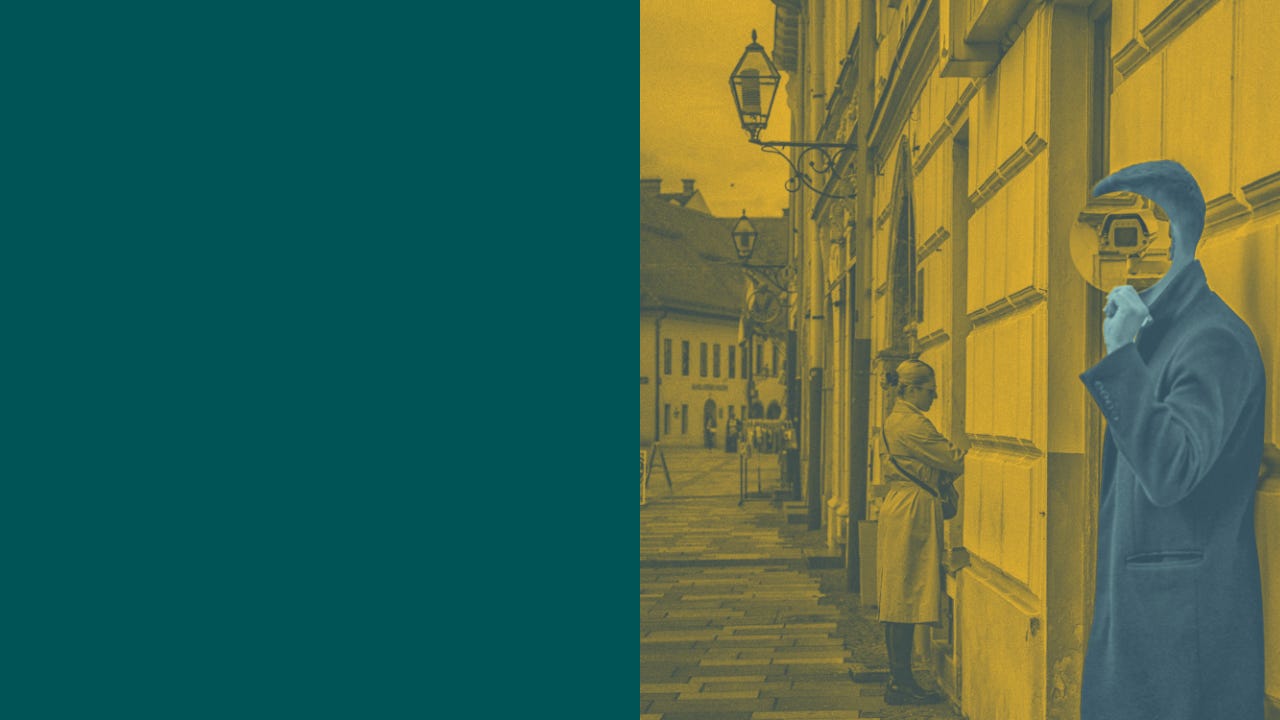
I don’t want a camera on the face of the person standing next to me in a queue. I don’t want the people I pass or interact with during an ordinary day taking footage of me home with them, into a device I know nothing about, headed somewhere I will never be told. I don’t want to be training Meta’s models. I don’t want to appear in someone’s content without being asked. But my objection isn’t only about me. It’s about what these glasses hand to two kinds of people:
The first is the one who means harm. Everyone can picture him. Face-worn cameras don’t create that person, they simply equip him. He no longer has to raise a phone, hold it steady, or explain himself if someone notices. He just has to turn his head in your direction. That is a change in what he can do, not in who he is.
The second is more common and gets discussed far less: The person who means nothing at all. Who bought the glasses because they looked good on Kylie, films without thinking about it, uploads without thinking about it, and has never once considered where any of it ends up. There is no malice anywhere in that chain. There doesn’t need to be. Your face is in his footage either way, and he is not the one who decides what happens to it next.
Where that footage goes is not a mystery. I wrote about it in March, after Swedish reporters found that contract workers had been reviewing intimate video captured by these glasses. Meta’s own terms are reasonably clear that human review happens. Most wearers have never read them.
That is a personal objection. You may not share it. Plenty of people don’t, and they’ll tell you privacy is something you gave up years ago and haven’t missed.
But I haven’t given it up. I miss it, and I intend to get some of it back.
Who is liable when a customer films your staff?
Whether you object personally or not, if you are a leader, then smart glasses are your ethical responsibility.
You are of course welcome to disagree with everything above. You are free to think I’m being a diva about a camera in a queue, that this is the same anxiety people had about camera phones in 2003, and that it will pass in the same way.
But if you are a leader, whatever you think about being filmed yourself, you are responsible for other people. Your staff. Your customers. Whoever walks into your building or joins your Zoom. That responsibility isn’t a matter of opinion and it doesn’t wait for you to form a view.
Here is what it looks like when nobody has thought about it:
Someone films your employees in your office. Someone films in your bathrooms, at the urinal or in your change rooms. A private internal meeting, the one where you discussed the restructure, now sits in someone’s camera roll. An interview candidate from a competitor walks past a whiteboard and captures the new strategy as it unfolds. Someone attends your paid training course, or a webinar with a no-recording condition, and records the whole thing anyway.
None of that requires bad intent. Most of it won’t have any.
And once it happens, it is gone. There is no law in England and Wales against filming a person in a public place, and no general right to your own image. If the wearer keeps the footage to themselves it likely sits outside data protection law altogether, under the exemption for purely personal activity. If they post it, that exemption falls away and they become a data controller with real obligations, which they will not know they have and which you have no practical way to enforce against someone you cannot identify until after the damage has been done.
Either way, the footage has left your building. You cannot retrieve it. You cannot delete it. You cannot find out where it went. It may be helping to train a model.
Businesses in the UK are already banning smart glasses
In June the government said it had no plans for specific legislation on camera-enabled glasses in public spaces, pointing instead to existing laws covering harmful conduct. So nobody is coming to sort this out for you.
So some businesses stopped waiting.
In early August, Wetherspoons told staff across more than 800 pubs to ask customers to switch the cameras off. Chief executive Tim Martin said the rule that you don’t film customers or employees without permission already existed, and that the glasses breach it by enabling surreptitious surveillance. The restaurateur Jeremy King banned them across Arlington, The Park and Simpsons in the Strand, saying he would never knowingly allow an invasion of guest privacy beyond the eyes people were born with. The court service in England and Wales banned them outright, reported on 11 August. Cinemas are now considering the same thing, mostly over piracy.
None of those organisations waited for a law. None of them needed one. They looked at what the devices do, checked it against rules they already had about filming people without consent, and made a decision.
You can do that too.
Why I’m backing the petition to ban smart glasses
A smart glasses policy protects your building. It does nothing about the street outside it, the train your staff take to get there, the school your children go to, or the pitch they play on at the weekend.
I don’t know what a full ban would do. I can’t model every consequence of taking a product off the shelves, and I’m suspicious of anyone who says they can. There are people who would lose something, arguments I haven’t heard, and second-order effects nobody has mapped.
That’s rather the point.
Nobody has had that argument. These went on sale and then onto faces without any public conversation about whether we wanted them there. In March a YouGov poll of 4,519 British adults found 49% support a ban on smart glasses in public spaces and 30% oppose one. Nobody asked those people anything before the products arrived.
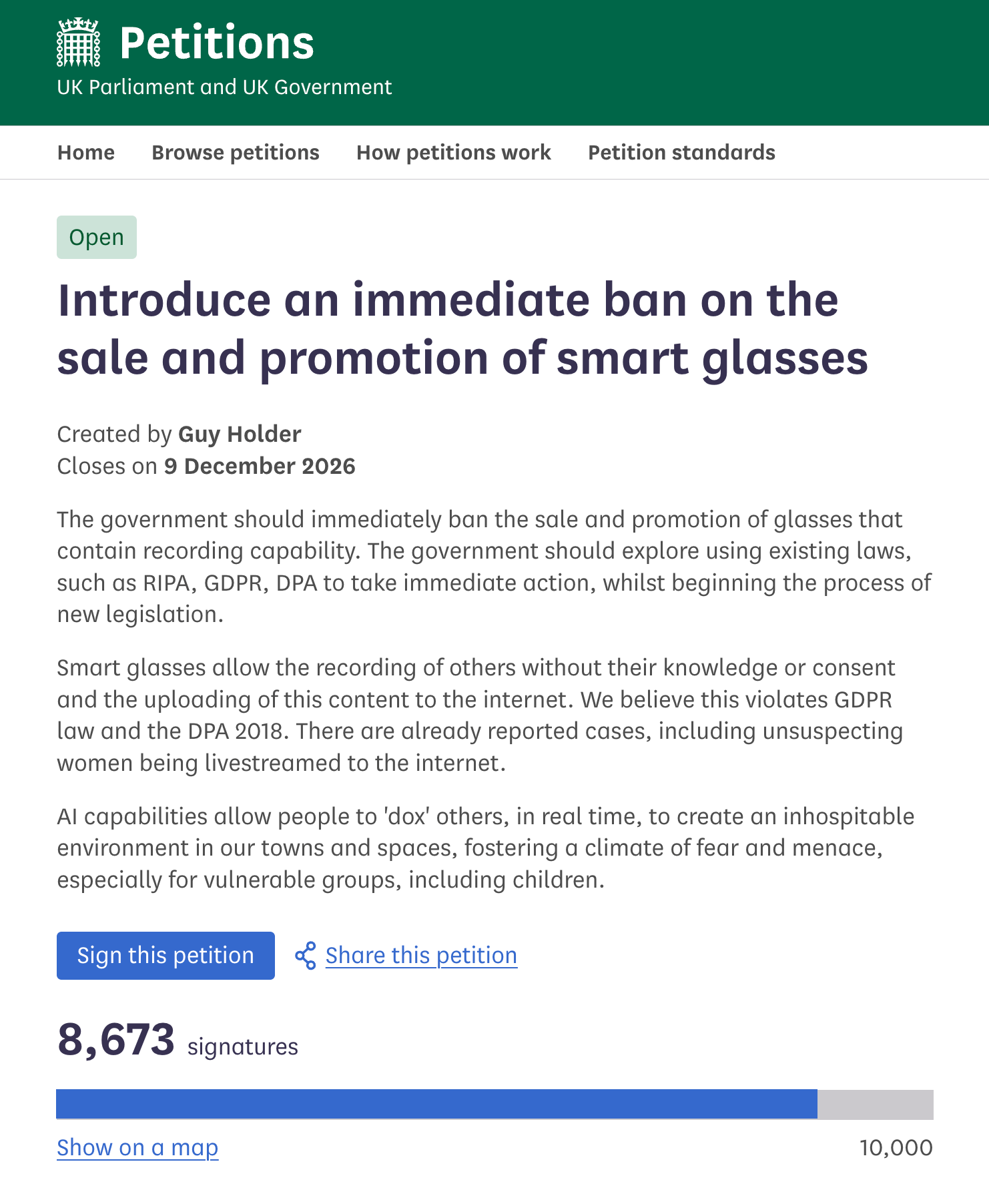
So I’m backing Guy Holder’s petition for an immediate ban on the sale and promotion of glasses with recording capability. Not because I’m certain it’s the right remedy. But because a petition that reaches 10,000 signatures forces the government to respond, and a response is the start of the debate we never had. I want the debate.
It’s at 8,673 today. It closes on 9 December.
And I’m also supporting the Stop Smart Glasses campaign
Signing takes thirty seconds. The campaign around it is more interesting.
Stop Smart Glasses was built by Liz Hunter, a London-based tech founder and copywriter, after she came across Holder’s petition. Holder is a teacher and co-founder of Set@16, which campaigns for 16 as the norm for exposure to smartphones, social media and generative AI. They’re now working together, with the petition as the campaign’s main route to political action (and my full support).
The site maps where Meta smart glasses are sold across the UK and Ireland. You search by postcode or town, find your local stockists and contact them directly. Alongside that it gives you routes to national retailers, to your MP, and to premises like schools, gyms and leisure centres that haven’t thought about this yet. The campaign describes it as the first UK and Ireland-wide database of its kind, which I haven’t independently verified but haven’t found anything to contradict.
If you have been waiting for permission to act on something you care about, this is what the permission looks like.
You do not need to resolve the national question to act on the local one. Those are separate decisions.
Decide what happens in your building. Whether they are allowed in, where, and what your people say when someone walks in wearing a pair. Wetherspoons managed it with a single instruction to staff. You are probably not facing a harder problem than a pub chain with 800 sites.
Then do the other thing. Sign the petition. Find out who is selling them near you and tell them to stop. Ask the schools, the gyms and the leisure centres your family uses whether they have thought about this at all, because most of them have not.
None of that requires you to be certain a ban is right. It requires you to think the question is worth asking in public, before the answer gets decided for us by whoever ships first.
I don’t consent to this. Do you?