

Google just announced that it’s bringing “advanced model capabilities to search with new AI features, enabling you to use agents just by asking a question.”
Allow me to translate: AI is going to be injected into Google search more than it already is. Yup. Google is going to “reimagine what Search can do with AI”.
Here are five reasons that’s not the upgrade Google thinks it is.
1. AI is bad at facts
AI is notoriously, empirically, objectively bad at facts. The hallucination problem is documented. It has not been solved.
Some of Google’s greatest hits so far:
Picking your nose and eating the mucus may help prevent cavities, stomach ulcers, and infections.
There are no countries in Africa beginning with the letter K.
Use glue to make your cheese stick to your pizza
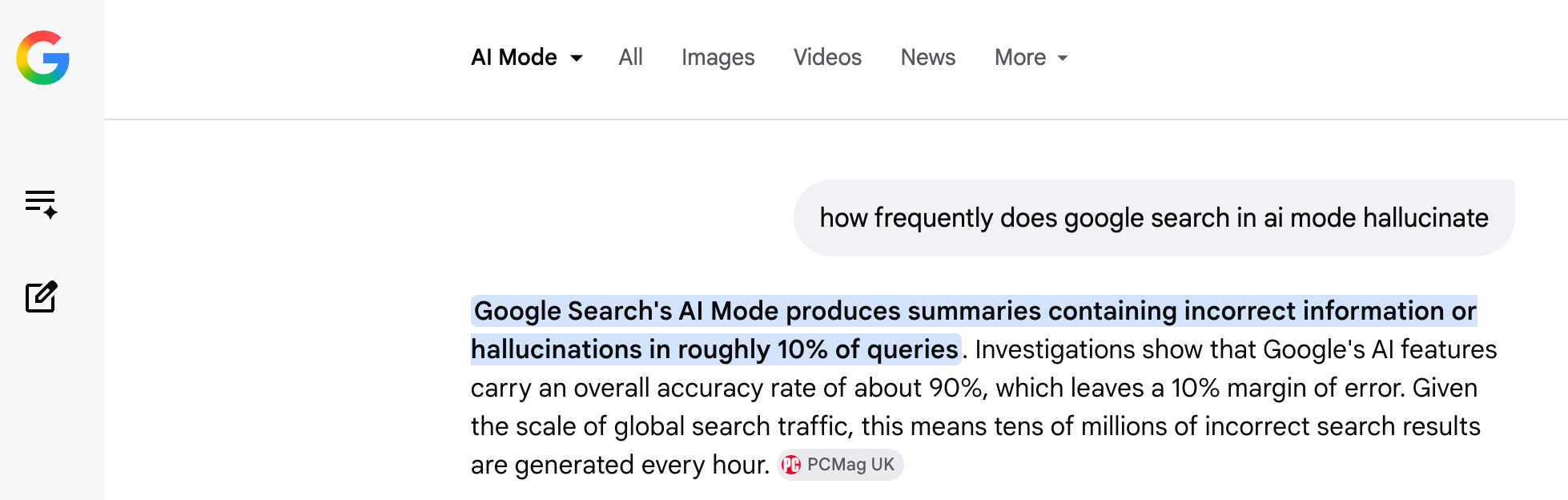
So now the one place we can go to get our own facts to make up our own minds is being contaminated by AI.
Don’t forget to hit the ❤️
2. No-one chose this
Google claims it’s reimagining search because that’s what users want. The proof, apparently, is that AI Mode now has more than one billion monthly users.
But did Google actually ask any of those one billion users whether they wanted AI in their search?
AI Overviews and AI Mode are defaults. They sit at the top of the search results page. Users didn’t choose between a list of links and an AI summary. They opened Google, and the summary was already there, marked as the answer. A billion people seeing AI Mode is not a billion people choosing AI Mode.
You can call a billion users a vote of confidence. You can also use your unparalleled distribution network to shove your product in front of a billion people whether they like it or not. Those are not the same thing.
3. More searches might not mean more demand
Google saw search queries reach an all-time high last quarter. The company takes this as evidence that people are searching more because people want more information.
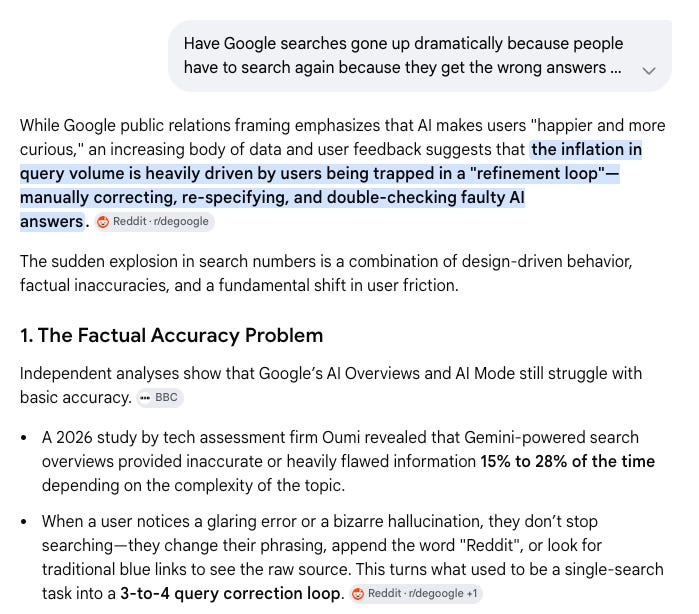
Maybe. Or maybe people are getting nonsensical AI answers and have to search again.
Did Google ask that question? I did (and I asked Google’s AI search mode).
4. Nobody asked for an information agent
Google is “taking the next step in its journey.” To “bring together the best of search engine with the best of AI.”
And because “your curiosity doesn’t always fit into keywords,” Google is introducing the biggest upgrade to the search box in over 25 years. “Intuitive, dynamically expanding to give you space to describe exactly what you need.” And to “anticipate your intent.” Helping you formulate your questions.
Lucky us. We’re entering the era of search agents. Information agents.
I don’t need anyone to anticipate my intent. I need them to answer my question.
5. Nobody asked what this costs the planet
What is the environmental cost of running all these unnecessary agentic searches?
I asked Google AI Mode. It told me (or maybe hallucinated at me) an agentic search uses ten times more energy than a regular one. In some cases up to thirty times. Multiply that by every keystroke search now being routed through AI Mode by default.
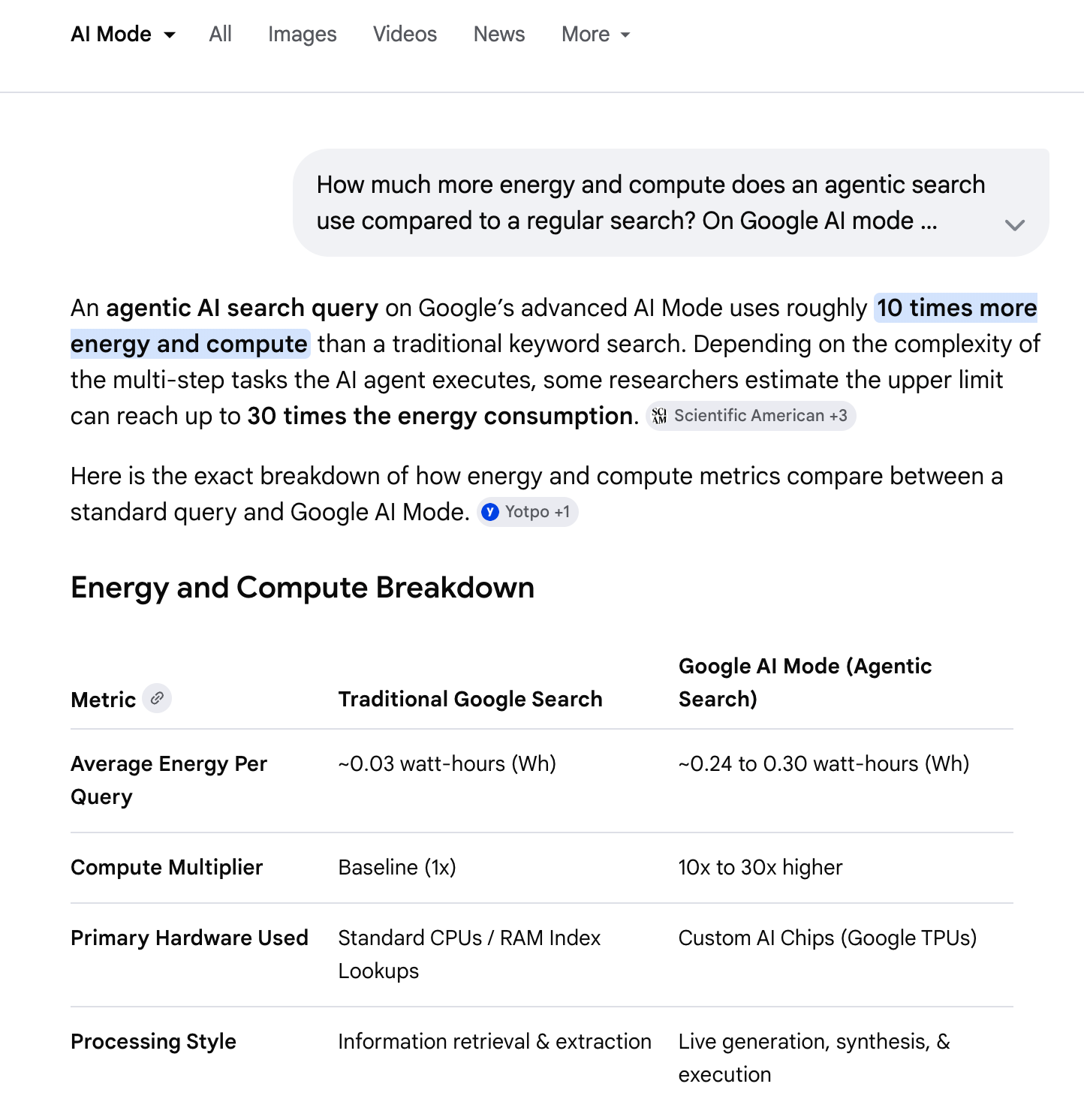
The new search uses ten times the energy of the old search. And nobody opted in.
You can opt out of Google AI mode
If you don’t want AI in your search, there is an alternative. It’s called DuckDuckGo. It’s a privacy-focused search engine that has been around for years as a quieter, less-tracked option to Google. It also has a dedicated AI-free search page at noai.duckduckgo.com that strips out AI-generated answers and AI-generated images entirely.
Since Google’s I/O announcement, DuckDuckGo downloads have surged 30%. The AI-free search page has seen similar growth, holding steady over a Memorial Day weekend when traffic normally dips.
“People just want a choice.” That is Kamyl Bazbaz, DuckDuckGo’s communications officer.
Google didn’t give us one. So people are making their own.
Google didn’t ask. But if you’d like to make better-informed choices about AI in your own business, my CPD-certified AI Fluency for Leaders course is for you. Three hours, no slop.
You're definitely right on about Google AI. I actually went to google to NOT have AI, and now that it mostly tries to force the AI on me, I've just defaulted to Claude (with me fact checking every link and fact).
It'll be interesting to see how this plays out a year from now. To be fair I hated Facebook when it came out and thought it was a fad...little did I know.... So who knows.
But at least today, I'm with you on this analysis.
Is there any scenario in which you think this goes gangbusters? And how do you feel about Google's shift into commerce (i.e.not sending traffic to you anymore and trying to be the place for commerce to happen?)
AI that a practitioner chooses and AI that a platform imposes are different. One makes you faster. The other makes you dependent.
The consent question isn't just about privacy. It's about whether people are developing any intuition about how to use these tools at all, or just outsourcing the thinking to whatever Google decides is the answer. And when the answer is wrong, most people don't know to question it. That's the scarier part.
What governance and awareness is actually being built around the impact on factual integrity in search? Because right now it feels like the infrastructure for critical thinking is being removed at the exact moment we need it most. We are trading the habit of verifying for the convenience of being told.